Why Your Clinic Isn’t Showing in Google Maps
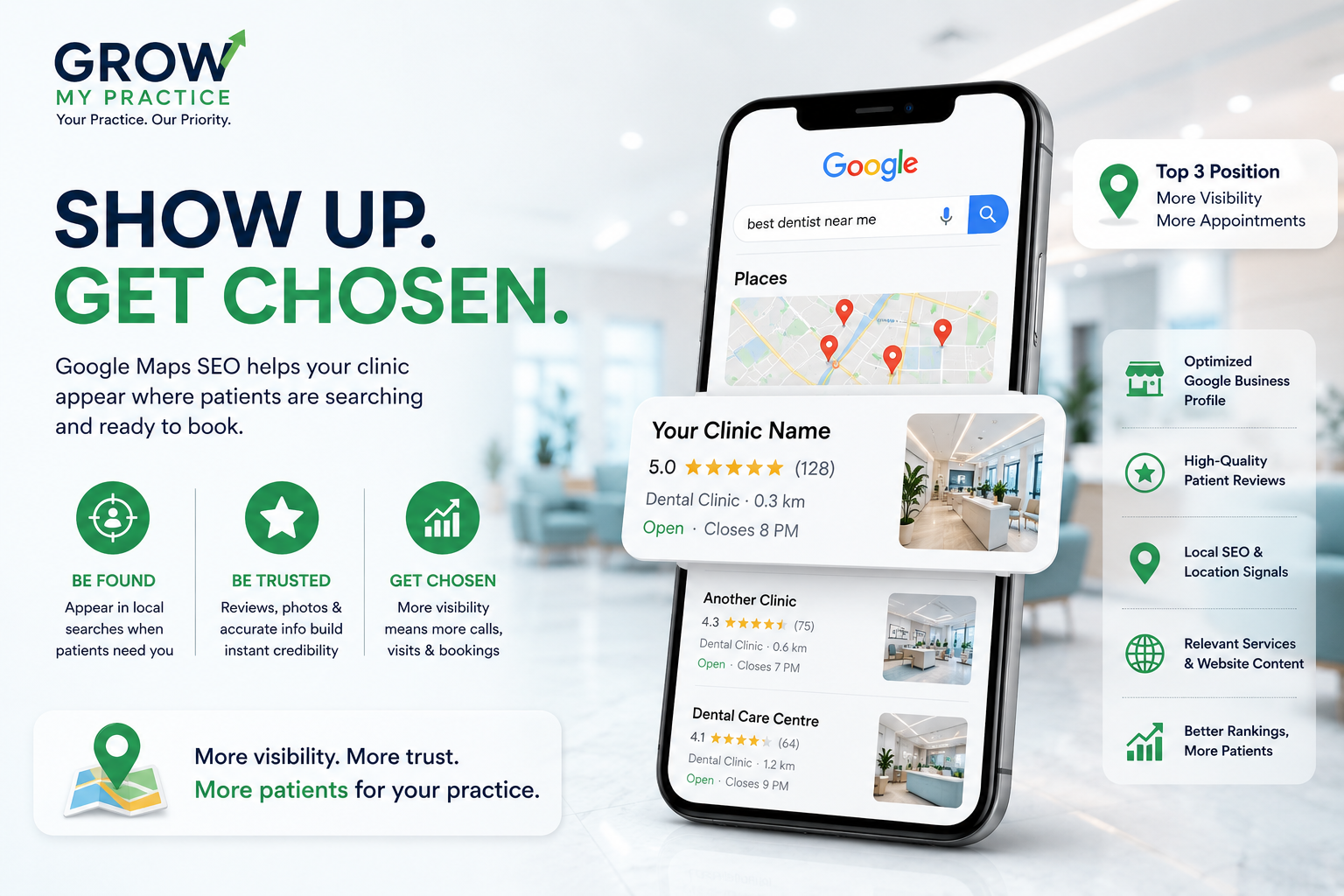
A patient searches “best dentist near me” or “dermatologist near me.” Your clinic is nearby. You have good reviews. Your doctors are experienced. Still, your name is missing from the Google Maps 3-Pack.
This is where many clinic owners feel confused. They assume more reviews should automatically improve visibility. But Google Maps SEO for clinics is not just about reviews. It depends on how clearly Google understands your clinic, how close you are to the searcher, and how trusted your clinic appears across the web.
For modern healthcare practices, Maps visibility is no longer a small digital detail. It directly affects calls, walk-ins, website visits, and booked appointments.
What Is Google Maps SEO for Clinics?
Google Maps SEO for clinics is the process of improving your clinic’s visibility in Google Maps and local search results when patients search for nearby healthcare services. For example:- “Dental clinic near me”
- “Skin specialist in Kolkata”
- “Hair transplant clinic near me”
- “Best dermatologist in Mangalore”
- “Root canal treatment near me”
Why Your Clinic Is Not Ranking on Google Maps
The biggest mistake doctors make is thinking Google Maps ranking is only about review count. Reviews matter, but they are not the whole system. Google mainly looks at three local ranking signals: relevance, distance, and prominence. At Grow My Practice, we call this the Maps Visibility Triangle.1. Relevance: Does Google Understand Your Clinic?
Relevance means how closely your Google Business Profile matches the patient’s search. If someone searches for “acne scar treatment near me,” Google needs to understand that your clinic offers acne scar treatment. If your profile only says “skin clinic” or “doctor,” you may lose visibility for treatment-specific searches. This is where Google Business Profile optimization becomes important. Your profile should clearly include:- Correct primary category
- Relevant secondary categories
- Detailed service list
- Treatment-specific descriptions
- Updated clinic hours
- Accurate phone number and website
- Real clinic photos
- Location-specific keywords
The Radius Problem: You May Rank in One Area, But Not Another
Distance is the most misunderstood part of clinic local SEO. A clinic owner may search from home and say, “We are not ranking.” But a patient searching 500 meters from the clinic may see the same clinic in the top results. Google Maps ranking changes based on the searcher’s location. This means your visibility is not one fixed position. It moves across different areas, streets, neighborhoods, and search terms. For example, a dental clinic in South Kolkata may rank well for patients nearby but not for people searching from Salt Lake. That does not always mean the profile is weak. It may mean the clinic is outside the strongest local radius for that search. This is why healthcare local SEO strategy should not depend on one manual search. You need to track visibility across multiple nearby locations.What Clinics Should Do
Instead of asking, “Do we rank on Google Maps?” ask:- Do we rank near the clinic?
- Do we rank in nearby residential areas?
- Do we rank for treatment-specific keywords?
- Do we rank for high-intent searches like “best,” “near me,” and “open now”?
- Which competitors appear repeatedly in our target radius?
Prominence: Why Competitors With Fewer Reviews May Rank Above You
Prominence means how trusted and well-known your clinic appears online. This includes patient reviews, but it also includes signals outside your Google Business Profile. Google may look at:- Review quality and frequency
- Review responses
- Website authority
- Local citations
- Healthcare directory listings
- Brand mentions
- Backlinks from trusted websites
- Consistent name, address, and phone details
- Local content on your website
- Patient-focused service pages
Common Google Business Profile Mistakes Clinics Make
Many clinics lose visibility because of small but damaging mistakes.Mistake 1: Choosing the Wrong Category
Your primary category has a strong impact on visibility. A dental implant clinic using only “Dental Clinic” may miss searches around implant-related treatments.Mistake 2: Leaving Services Empty
Google needs treatment-level clarity. If your services are missing, your profile becomes too broad.Mistake 3: Using Generic Photos
Stock images do not build the same trust as real clinic photos. Patients want to see the reception, consultation room, equipment, doctor, team, and overall environment.Mistake 4: Ignoring Review Replies
Replying to reviews shows activity and care. It also gives you a natural way to reinforce trust without sounding promotional.Mistake 5: Website and Profile Mismatch
If your Google profile says one thing and your website says another, Google gets mixed signals. Your services, location, phone number, and clinic name should match everywhere.A Practical Framework to Improve Clinic Visibility on Google Maps
Here is a simple 5-step framework Grow My Practice uses when auditing Google Maps SEO for clinics.Step 1: Fix the Foundation
Start with the basics. Make sure your clinic name, address, phone number, website, categories, hours, and appointment link are accurate.Step 2: Build Service Relevance
Add every real service your clinic wants to rank for. Keep the descriptions simple and patient-friendly. Use treatment terms patients actually search.Step 3: Strengthen Local Trust
Add real photos, doctor images, treatment room images, clinic exterior photos, and updated posts. Make your profile feel active and real.Step 4: Improve Review Quality
Do not chase only star ratings. Ask happy patients to mention the treatment, experience, location, and doctor naturally. A detailed review often carries more trust than a short “good clinic” review.Step 5: Connect Website SEO With Maps SEO
Your website should support your Google Business Profile. Create strong service pages for key treatments and include local terms naturally. A clinic trying to rank for “root canal treatment in Kolkata” needs a page that clearly explains that service, not just a general dental page.Case Insight: Why a Dermatology Clinic May Stay Invisible
Imagine a dermatology clinic with 4.8 stars and 80 reviews. On paper, it looks strong. But its Google Business Profile has only one category, no service descriptions, three old photos, no appointment link, and no treatment-specific pages on the website. Nearby competitors have fewer reviews but better categories, detailed services, strong local pages, regular photos, and consistent citations. In this case, the issue is not medical expertise. The issue is digital clarity. Google cannot rank what it does not clearly understand. This is why clinic local SEO must connect profile optimization, website content, reviews, photos, and local authority together.Treat Google Maps Like a Patient Decision Page
Your Google Business Profile is not just a listing. For many patients, it is the first consultation touchpoint. Before they call, they check:- Is this clinic near me?
- Is it open now?
- Do people trust this doctor?
- Does the clinic offer my treatment?
- Does the place look professional?
- Can I book easily?